
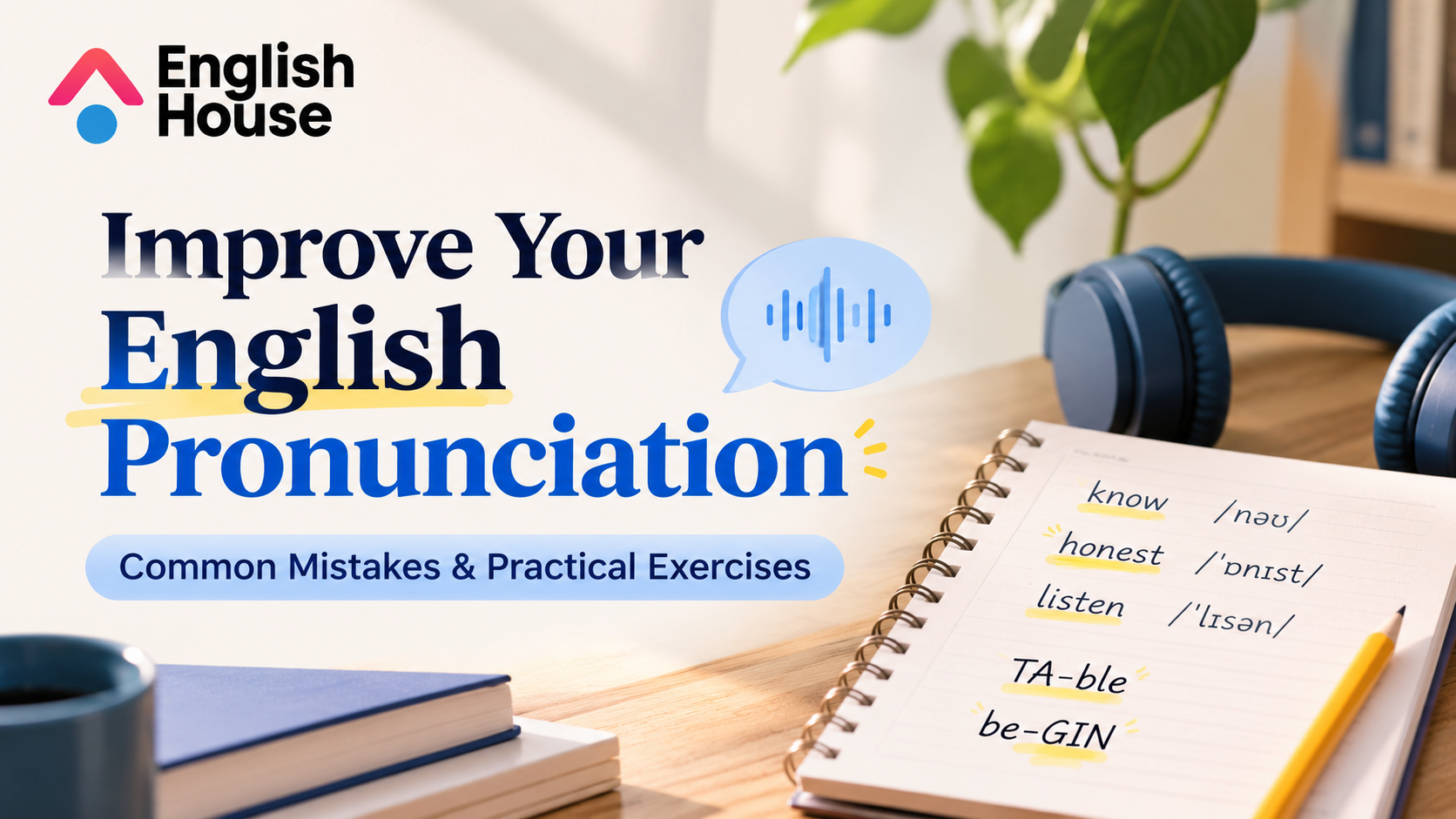

Has someone ever asked you to repeat a sentence because they couldn’t understand what you said? You’re not alone. English pronunciation can be challenging, especially when you’re used to speaking a language with different sounds, stress patterns and speaking rhythms.
The good news is that you don’t need to speak English like a native speaker to communicate clearly. You need to pronounce words in a way that others can understand, use the right word stress and speak with confidence.
With regular practice and a few simple techniques, you can gradually improve your pronunciation. Whether you’re learning independently or attending an online spoken English course, understanding common pronunciation mistakes is a good place to start.
Why Is English Pronunciation Important?
Pronunciation plays an important role in effective communication. Even when your grammar and vocabulary are good, unclear pronunciation can sometimes make it difficult for others to understand your message.
Here are a few reasons why working on your pronunciation matters.
Clearer communication: Correctly pronouncing words helps listeners understand what you mean without repeatedly asking you to explain.
Better speaking confidence: When you know how to pronounce unfamiliar words, you may feel more comfortable participating in conversations, meetings and discussions.
Improved listening skills: Learning to recognise English sounds can also help you understand other speakers, especially when they speak naturally or quickly.
Stronger professional communication: Clear pronunciation can be particularly useful during job interviews, presentations, client calls and workplace conversations.
Common English Pronunciation Mistakes
Many English learners make similar pronunciation mistakes. Identifying these errors can help you understand what to practice.
Mispronouncing silent letters
English spelling does not always tell you which letters to pronounce.
Consider these examples:
- Know: The ‘k’ is silent.
- Honest: The ‘h’ is silent.
- Listen: The ‘t’ is silent.
- Debt: The ‘b’ is silent.
Trying to pronounce every written letter can make your speech sound unnatural.
How to improve: When learning a new word, check its pronunciation using a reliable dictionary with audio. Learn the spoken form along with its spelling.
Placing stress on the wrong syllable
In English, one syllable in a word often receives more emphasis than the others. Placing stress on the wrong syllable can make a word harder to recognise.
For example:
- TA-ble: Stress on the first syllable.
- be-GIN: Stress on the second syllable.
- IM-por-tant: Stress on the first syllable.
Word stress can also change the meaning or grammatical role of some words. For example, RE-cord is commonly a noun, while re-CORD is commonly a verb.
How to improve: Listen to the word before repeating it. Notice which syllable sounds stronger and practice reproducing that pattern.
Pronouncing every word separately
When speaking English, words often connect naturally. Pronouncing every word as though it stands alone can make your speech sound hesitant.
How to improve: Practice complete phrases and short sentences instead of focusing only on individual words. Pay attention to how sounds connect in natural speech.
Confusing the ‘v’ and ‘w’ sounds
Some learners find it difficult to distinguish between words such as vine and wine.
To produce the ‘v’ sound, gently touch your upper teeth to your lower lip and let your voice vibrate. For the ‘w’ sound, round your lips without touching your upper teeth to your lower lip.
How to improve: Practice word pairs such as vest–west, vine–wine and vow–wow. Start slowly and focus on the position of your lips and teeth.
Practical Ways to Improve English Pronunciation
You don’t need expensive equipment or hours of daily practice to improve your pronunciation. A few consistent habits can make a difference.
Listen and repeat
Choose a short audio clip featuring clear English speech. Listen to one sentence, pause the audio and repeat the sentence as closely as possible.
Try to notice the speaker’s vowel and consonant sounds, word stress and rhythm. Repeat the same sentence several times before moving to the next one.
Use the shadowing technique
Shadowing is a technique in which you speak along with an audio recording or repeat what you hear with very little delay.
Start with a short clip from an English lesson, interview or educational video. Listen to the speaker and try to follow the same pace and rhythm.
If the clip is too fast, slow it down initially. Gradually increase the speed as you become more comfortable.
Record yourself speaking
Your pronunciation may sound different to you when you hear a recording of your own voice.
Choose a short paragraph and read it aloud. Record yourself, listen to the playback and identify words that sound unclear or differ from the pronunciation you hear in a dictionary.
Repeat the paragraph after working on those words. Compare your recordings over time to notice your progress.
Learn pronunciation along with vocabulary
Whenever you learn a new English word, don’t focus only on its meaning and spelling.
Listen to its pronunciation, identify the syllables and check where the stress falls. Then use the word in a sentence.
This habit helps you build vocabulary that you can confidently use in everyday conversations.
Practise with other people
Speaking with another person gives you an opportunity to use what you’ve learnt in real conversations. You can ask for feedback, clarify unfamiliar words and practise speaking without relying entirely on prepared sentences.
If you prefer guided learning, a structured spoken English course can help you practice pronunciation alongside listening, vocabulary and everyday communication.
Simple English Pronunciation Exercises
Here are five exercises you can try at home. Spend around 10–15 minutes practising them each day
Exercise 1: Minimal pairs
Minimal pairs are words that differ by just one sound. Practising them helps you recognise and produce sounds more accurately.
Try these pairs:
- Ship – Sheep
- Bat – Bet
- Fan – Van
- Vest – West
- Thin – Tin
Say each pair slowly, paying attention to the difference between the sounds. Then use each word in a short sentence.
Exercise 2: Practise the ‘th’ sound
The ‘th’ sound can be challenging because it is produced differently from sounds such as ‘t’ and ‘d’.
Try words such as:
- Think
- Three
- Thank
- This
- Those
For the sounds in think and three, gently place the tip of your tongue between your teeth and push air out. For the sounds in this and those, use the same tongue position but add your voice.
Practise slowly before using the words in complete sentences.
Exercise 3: Clap out word stress
Choose words with two or more syllables. Say each word aloud and clap once on the stressed syllable.
Try these examples:
- TA-ble
- DOC-tor
- be-GIN
- im-POR-tant
- com-MU-ni-cate
The capitalised syllables indicate where the stress falls. Clapping can help you become more aware of the rhythm of English words.
Exercise 4: Read a tongue twister
Tongue twisters help you practise difficult sound combinations and improve your control over speech.
Start with this familiar example:
“She sells seashells by the seashore.”
Say it slowly, concentrating on the ‘s’ and ‘sh’ sounds. Once you can pronounce each word clearly, gradually increase your speed.
The aim is clarity, not speed. If the words become difficult to understand, slow down again.
Exercise 5: Read aloud and record
Choose a short paragraph from a book or an English learning resource. Read it aloud and record your voice.
Listen to the recording and check three things:
- Are you pronouncing the words clearly?
- Are you placing stress on the right syllables?
- Are you pausing naturally between phrases?
Read the same paragraph again, focusing on the areas you want to improve. Repeat the exercise after a few days to track your progress.
How to Practise English Pronunciation Every Day
Improving pronunciation takes time, so consistency is more useful than practicing for a long time once in a while.
Here’s a simple daily routine you can follow.
- Listen to English daily: Use podcasts, interviews, audiobooks or educational videos.
- Keep a pronunciation notebook: Write down unfamiliar words and their correct pronunciations.
- Practise in real situations: Use new words in conversations with friends, colleagues or fellow learners.
- Be patient with yourself: Some sounds take longer to master than others. Improvement comes through repeated practice.
If you find it difficult to identify your own mistakes, feedback from a trainer or a proficient English speaker can help you work on them more effectively.
Frequently Asked Questions
1. How can I improve my English pronunciation at home?
Listen to clear English audio, repeat words and sentences, practise difficult sounds and record yourself speaking. Even 10–15 minutes of focused daily practice can help you build better pronunciation habits over time.
2. How long does it take to improve English pronunciation?
It depends on your current level, the sounds you find difficult and how regularly you practise. You may notice improvements in familiar words within a few weeks, while developing consistent pronunciation across different conversations can take longer.
3. Can I improve my English pronunciation without a trainer?
Yes. Audio dictionaries, educational videos, recordings and shadowing exercises are useful self learning tools. However, a trainer can help you identify mistakes that you may not notice yourself and suggest targeted exercises.
4. Do I need to change my accent to speak English clearly?
No. You don’t need to adopt a British, American or any other accent to communicate effectively. Focus on clear sounds, appropriate word stress and understandable speech rather than trying to sound like someone else.
5. Are online spoken English classes useful for improving pronunciation?
They can be useful when they include opportunities to speak, listen, repeat and receive feedback. Look for online spoken English classes that offer interactive speaking practice and guidance from trainers rather than lessons that focus only on grammar and vocabulary.
Improve Your Spoken English with English House
At English House, pronunciation is an important aspect of all our courses. Right from the basic level course, we encourage beginners to get their sounds and intonation right. As they progress to intermediate and advanced level courses, we make sure they are exposed to commonly mispronounced words, MTI (Mother Tongue Influence) reduction and accent training.
Explore English House to find a learning option that suits your goals and take the next step towards more confident English communication.
