
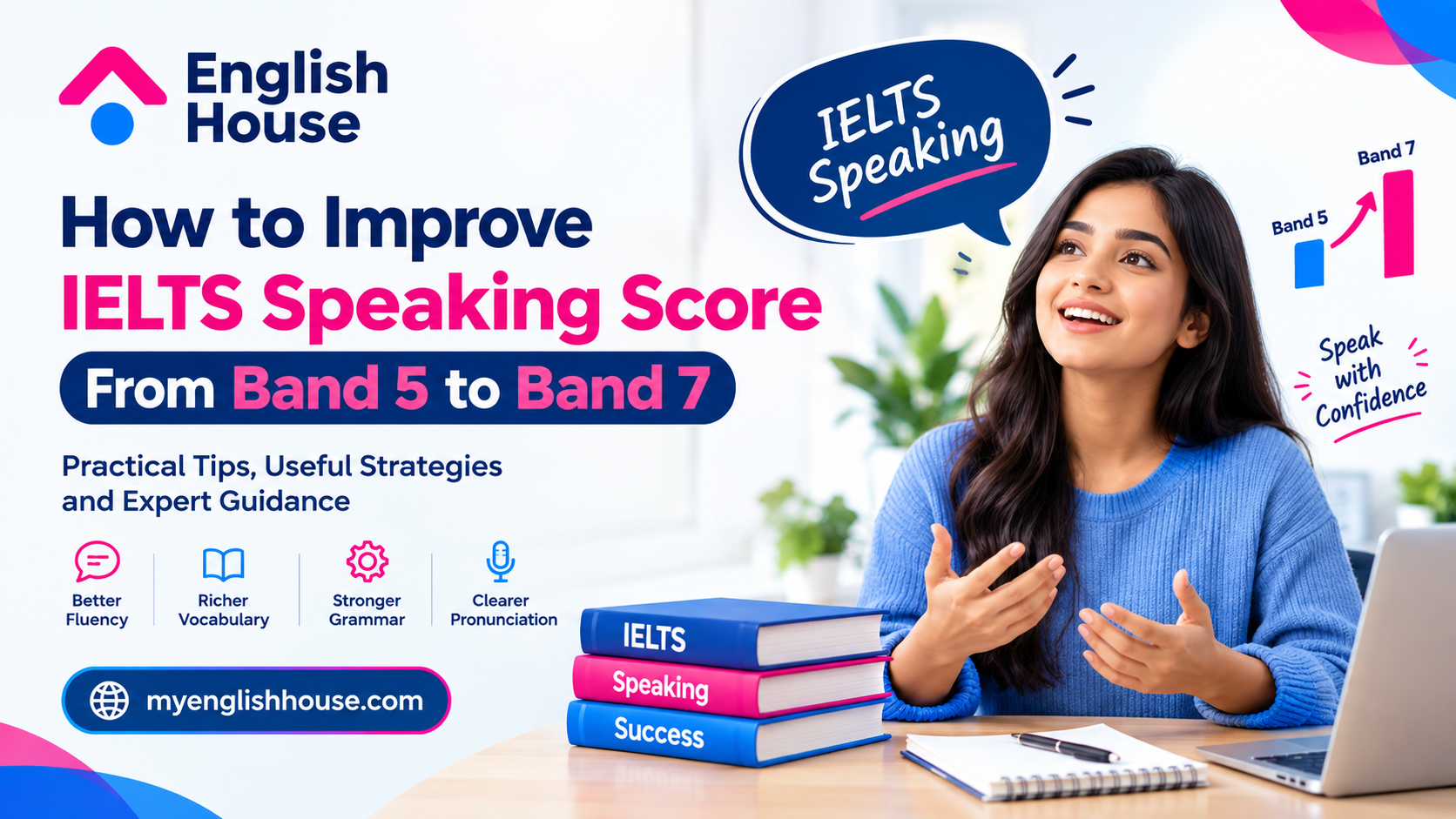

Getting an IELTS Speaking score of Band 5 and reaching Band 7 are two very different stages of
English communication. At Band 5, you may be able to communicate your ideas, but pauses,
limited vocabulary, grammar mistakes or unclear pronunciation can affect how effectively you
express yourself.
The good news is that moving from Band 5 to Band 7 is achievable with focused practice. Instead
of simply speaking more English, you need to work on how clearly, naturally and accurately you
communicate.
This guide covers the key areas to focus on if you want to improve your IELTS Speaking score
from Band 5 to Band 7.
Band 5 vs Band 7: What Changes?
The IELTS Speaking test is assessed across four areas:
- Fluency and Coherence
- Lexical Resource (Vocabulary)
- Grammatical Range and Accuracy
- Pronunciation
A Band 5 speaker can usually communicate basic ideas but may rely on simple vocabulary, make
frequent grammatical errors and hesitate when trying to explain something.
A Band 7 speaker is expected to speak at greater length, organise ideas more clearly, use a wider
range of vocabulary and grammar and communicate with much less effort.
The key difference is not about using complicated English all the time. It is about being able to
express your ideas clearly, flexibly and naturally.
1. Improve Your Fluency
Fluency is more than speaking quickly. It is about being able to develop your ideas without
excessive hesitation or losing your train of thought.
If you often stop because you are trying to find the perfect word or translate from your first
language, start practising without overthinking every sentence.
Try this:
Choose a familiar topic such as:
- Your hometown
- Your favourite hobby
- A memorable trip
- Your future plans
- A person you admire
Speak about it for one to two minutes without stopping.
Don’t worry about making mistakes during your first attempt. Record yourself, listen back and
identify where you paused or struggled. Then try the same topic again.
This simple speak → review → repeat method can gradually make your responses more natural.
One important rule:
Don’t memorise complete answers.
IELTS examiners can notice when an answer sounds rehearsed. Instead, prepare ideas, useful
expressions and examples that you can adapt to different questions.
2. Improve Your Vocabulary
Moving from Band 5 to Band 7 does not mean learning hundreds of difficult words.
What matters more is having enough vocabulary to express your ideas precisely and naturally.
For example, instead of repeatedly saying:
“It was very good.”
You could explain what made it good:
“It was a really rewarding experience because I got the opportunity to meet people from different
backgrounds.”
The second answer gives more detail and uses vocabulary that communicates the idea more
precisely.
Build vocabulary by topic
Choose common IELTS topics such as:
- Education
- Technology
- Environment
- Health
- Work
- Travel
- Social media
- Family and relationships
For each topic, learn:
Useful words + natural phrases + your own examples
Don’t just memorise a list of words. Use every new word in your own sentences and conversations.
Try the “3 uses” technique
Whenever you learn a new word:
- Write its meaning.
- Create a sentence using it.
- Use it while speaking about a real experience.
This helps move vocabulary from passive knowledge to active speaking.
3. Improve Your Grammar
You don’t need perfect grammar to get a high IELTS Speaking score. However, frequent errors can
limit your score.
At Band 5, speakers may rely heavily on simple sentence structures and make repeated errors with
areas such as:
- Verb tenses
- Prepositions
- Subject-verb agreement
- Sentence structure
To move towards Band 7, start using a wider range of sentence structures while maintaining
reasonable accuracy.
For example:
Simple:
“I started learning English when I was young. I enjoyed it.”
More developed:
“Although I started learning English at a young age, I became more interested in it when I realised
how useful it was for communicating with people from different countries.”
The goal isn’t to make every sentence complicated. It’s to show that you can combine simple and
complex structures naturally.
4. Improve Your Pronunciation
Good pronunciation doesn’t mean having a particular British, American or Australian accent.
For IELTS, the important thing is whether your speech is clear and easy to understand.
Pay attention to:
- Word stress
- Sentence stress
- Intonation
- Individual sounds
- Linking between words
- Common pronunciation mistakes
Record yourself speaking and compare your pronunciation with reliable English audio sources.
You can also choose a short audio clip, listen to it several times and then try to reproduce the
speaker’s rhythm and intonation. This technique is often called shadowing.
The aim is not to copy an accent. It is to become more comfortable with the rhythm and sound
patterns of natural English.
5. Practise Common IELTS Speaking Questions
Knowing the format of the IELTS Speaking test can make your preparation more focused.
Practise questions from all three parts of the test.
Part 1: Familiar topics
Questions about areas such as your home, work, studies, hobbies and daily life.
Focus on giving answers that are more than one sentence without becoming unnecessarily long.
Part 2: Long turn
You receive a topic and have time to prepare before speaking for up to two minutes.
Practise organising your thoughts quickly.
A simple structure can help:
What → When/Where → Details → Why it mattered
Part 3: Discussion
These questions are usually more abstract and require you to explain opinions, reasons,
comparisons and consequences.
Instead of giving only:
“Yes, I agree.”
Try developing the idea:
“Yes, I agree to some extent. One reason is that… Another factor is…”
The more you practise explaining and developing ideas, the more comfortable you become with
Part 3.
A Simple Band 5 to Band 7 Practice Routine
You don’t necessarily need hours of study every day. Consistent, targeted practice can be more
useful.
Try this routine:
10 minutes – Vocabulary
Learn and use useful expressions around one topic.
15 minutes – Speaking
Answer IELTS-style questions aloud.
10 minutes – Recording & Review
Listen to yourself and identify pauses, repeated words and grammar mistakes.
10 minutes – Repetition
Answer the same question again, this time trying to improve your response.
5 minutes – Pronunciation
Practise difficult words, stress and intonation.
The most important part is speaking aloud. Reading about IELTS Speaking will not improve your
speaking as much as actually using English.
Use AI as a Speaking Practice Partner
AI tools can also make independent IELTS preparation more interactive. You can use prompts to
practise questions, receive feedback and generate new topics.
For example:
Prompt 1 – Speaking Practice
“Act as an IELTS Speaking examiner. Ask me Part 1 questions one at a time. Wait for my answer
before asking the next question.”
Prompt 2 – Feedback
“Analyse my IELTS Speaking answer for fluency, vocabulary, grammar and pronunciation. Identify
my three biggest areas for improvement and suggest better ways to express my ideas.”
Prompt 3 – Band 7 Vocabulary
“Give me 10 natural vocabulary phrases I can use when speaking about technology in IELTS. Give
one example sentence for each and avoid overly complicated words.”
Prompt 4 – Part 3 Practice
“Give me five IELTS Speaking Part 3 questions about education. After each answer, ask a follow-up
question that makes me explain or justify my opinion.”
AI can be useful for additional practice, but it should complement and not replace feedback from a
qualified IELTS trainer, particularly for pronunciation and speaking performance.
How Long Does It Take to Move From Band 5
to Band 7?
There is no fixed timeline. It depends on your current ability, how consistently you practise and
which areas are holding your score back.
If your main problem is hesitation, you may need more speaking practice.
If your vocabulary is limiting your answers, you may need focused vocabulary development.
If grammar errors are frequent, targeted grammar practice can help.
And if your pronunciation affects clarity, regular pronunciation practice and expert feedback may be
important.
The key is to identify your weakest areas instead of practising everything equally.
For learners who prefer structured guidance, an online IELTS speaking course like the one being
offered by English House can provide regular practice, feedback and a clear learning plan without
requiring you to attend physical classes. English House, for example, offers online IELTS training
designed to support learners through structured preparation and guided practice.
From Band 5 to Band 7: Focus on Progress,
Not Perfection
A Band 7 speaker isn’t someone who never makes a mistake.
They are someone who can keep a conversation going, develop their ideas, use vocabulary flexibly,
control a range of grammar and communicate clearly.
So don’t make your goal “speak perfect English.”
Make it:
Speak more.
Speak clearly.
Develop your ideas.
Learn from your mistakes.
Practise again.
With consistent, focused practice, your speaking can move from simply answering questions to
communicating with confidence and that is the real difference between knowing English and being
able to use it effectively.
Frequently Asked Questions
1. Can I improve my IELTS Speaking score from Band 5 to Band 7?
Yes. Improvement depends on your current strengths and weaknesses, the amount and quality of
practice you do and how consistently you work on the four IELTS Speaking assessment areas.
2. How can I improve my IELTS Speaking fluency?
Speak regularly without preparing complete answers. Record yourself, review your pauses and
repeated words and answer the same question again while trying to improve your delivery.
3. Is vocabulary important for Band 7?
Yes, but learning difficult words is not the goal. You need to use a wider range of vocabulary
appropriately and naturally while expressing your ideas clearly.
4. Can I prepare for IELTS Speaking online?
Yes. Online IELTS speaking classes can provide structured lessons, speaking practice and feedback
from trainers. They can also be useful for learners who need flexibility in their preparation schedule.
5. Can AI help with IELTS Speaking practice?
AI can help you generate questions, practise conversations, develop vocabulary and review written
transcripts of your answers. However, it works best as an additional practice tool alongside
structured preparation and expert feedback.
6. What is the best way to improve IELTS Speaking from Band 5 to Band 7?
Start by identifying what is limiting your current score. Then practise fluency, vocabulary, grammar
and pronunciation consistently, while regularly answering IELTS-style questions and getting
feedback on your performance. English House, for example, offers online IELTS training designed
to support learners through structured preparation and guided practice
