
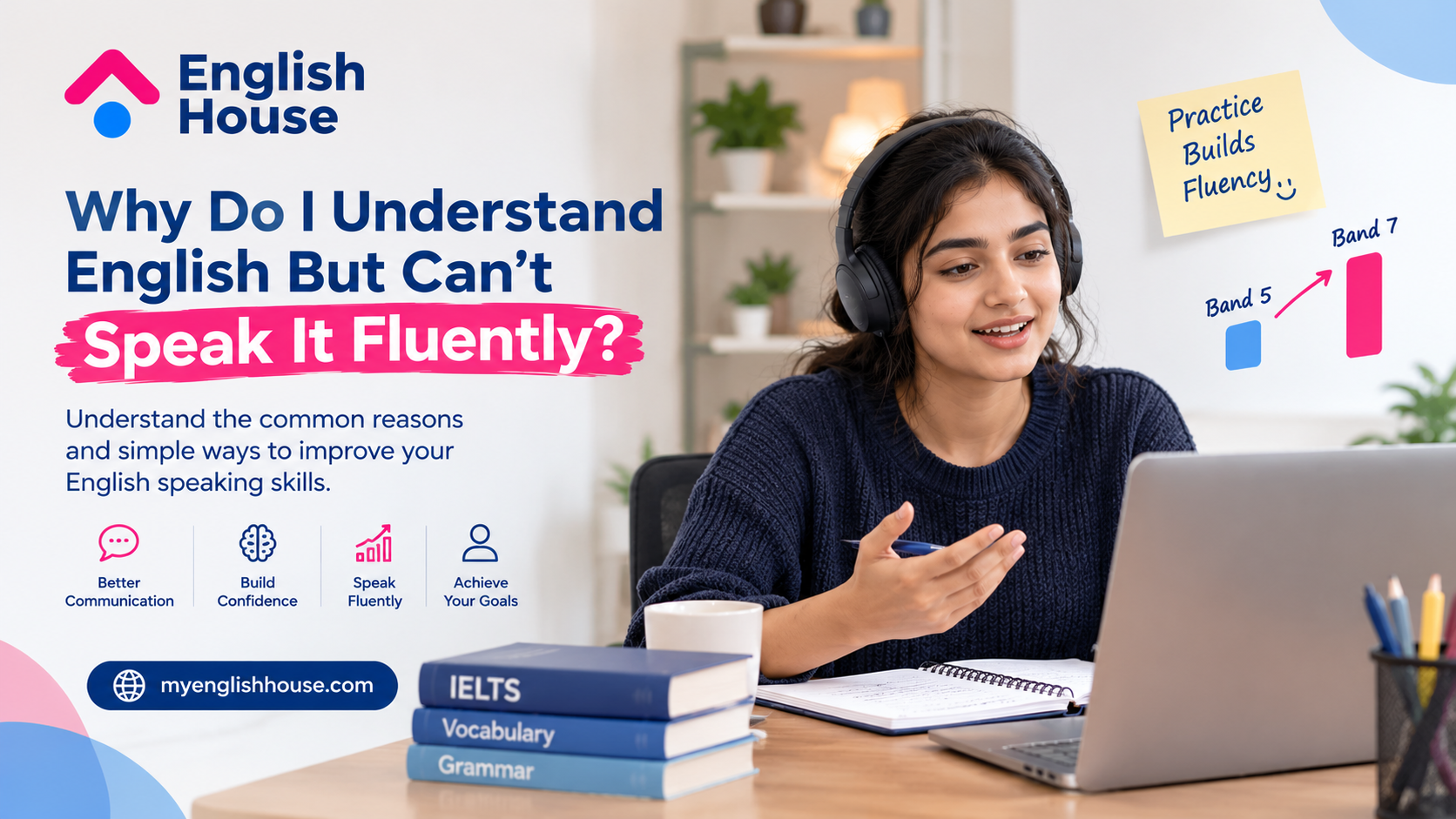

Have you ever understood an English movie, followed a conversation or read an article without
much difficulty, but suddenly struggled to find the right words when it was your turn to speak?
If yes, you are not alone.
Many English learners in India have a good understanding of English but find speaking much
harder. This happens because understanding a language and actively using it are two different skills.
You may have built a strong passive vocabulary through school, work, films, social media and
reading, but speaking requires you to retrieve words, form sentences and express ideas in real time.
The good news is that fluency is not something you either have or don’t have. It is a skill that
improves with consistent speaking practice
Why Does This Happen?
There are several reasons why someone can understand English well but struggle to speak it
fluently.
1. Fear of Making Mistakes
One of the biggest barriers to speaking English is the fear of being wrong.
You may know exactly what you want to say but start thinking:
“Is this grammar correct?”
“What if I pronounce this word incorrectly?”
“What will people think if I make a mistake?”
By the time you have checked every sentence in your head, the conversation has already moved on.
Fluency does not mean speaking without mistakes. It means being able to keep communicating
even when your English isn’t perfect. Mistakes are part of the learning process and regular speaking
helps you become more comfortable with them.
2. Lack of Speaking Practice
You cannot develop speaking fluency through listening and reading alone.
You might spend hours watching English videos or learning new vocabulary, but if you rarely
speak, your brain does not get enough practice producing English spontaneously.
This is why English speaking practice online can be useful when it involves actual interaction rather
than simply watching lessons. The more frequently you speak, the easier it becomes to form
sentences naturally.
3. Translating From Your Mother Tongue
Another common problem is mentally translating every sentence before saying it.
You first think in Malayalam or another familiar language, translate the thought into English and
then try to speak it.
This extra step makes speaking slower and can cause hesitation.
The goal is gradually to develop the ability to form simple thoughts directly in English. You don’t
need to stop thinking in your mother tongue overnight. Instead, start with everyday thoughts and
expressions and slowly build the habit.
How Can You Improve Your English Speaking Fluency?
There is no single shortcut to becoming fluent. What works is regular, active and practical use of
English.
1. Practise Speaking Every Day
Even 15–20 minutes of daily speaking can make a difference when you practise consistently.
You can:
Talk about what you did during the day.
- Describe something you can see around you.
- Explain your opinion on a topic.
- Retell a story or video you watched.
- Record yourself speaking and listen back.
- Speak with a friend or conversation partner.
- Practise answering common interview or workplace questions.
Don’t wait until you have the “perfect” sentence. Start speaking with the English you already know.
2. Use English in Real Situations
Try to move beyond textbook sentences.
If you are learning English for work, practise introducing yourself, participating in meetings,
explaining an idea or speaking to a customer.
If you are learning for everyday communication, practise conversations you actually have making
plans, asking for information, expressing an opinion or telling someone about your day.
The more relevant the practice, the easier it is to transfer what you learn into real conversations.
3. Reduce Hesitation by Practising in Small Steps
If hesitation is your biggest problem, don’t begin by trying to speak for 30 minutes.
Start with one minute.
Choose a simple topic and speak without stopping. Then gradually increase the time.
You can also use prompts such as:
- “What did I do today?”
- “What is one thing I would like to change?”
- “What is my favourite place and why?”
- “What did I learn this week?”
- “What would I do if I had a free day?”
The objective is not perfect grammar. It is to train yourself to think, formulate and speak in English
without constantly stopping to translate.
4. Learn From Conversations, Not Just Corrections
Grammar correction is useful, but fluency also requires understanding how English is naturally
used.
Pay attention to phrases people use in everyday conversations. Notice how they begin an answer,
express disagreement, give an opinion, change a topic or explain something.
This helps you build a bank of ready-to-use expressions that make speaking more natural.
Can Online English Classes Help?
They can, especially when the focus goes beyond watching recorded lessons.
Good spoken English online classes should give learners opportunities to actually speak, receive
useful feedback and practise in situations that resemble real conversations.
For learners looking for an online English speaking course, the important thing is not simply the
number of lessons. Look for a learning environment where speaking is a regular part of the class
and where you can practise without being afraid of making mistakes.
This is also where guided learning can make a difference. At English House, a Kerala-based English
training company, learners practise spoken English through structured activities, conversations and
mentor feedback rather than relying only on grammar-based learning.
What About AI for English Speaking Practice?
AI tools can also become useful practice partners.
You can ask an AI tool to:
- Give you a daily speaking topic.
- Ask you follow-up questions.
- Simulate a job interview.
- Role-play a workplace conversation.
- Correct your sentences after you finish speaking.
- Suggest more natural ways to express an idea.
- Help you build vocabulary around a particular topic.
However, AI practice works best as a supplement to real human communication, not a complete
replacement for it.
Real conversations involve interruptions, different speaking styles, spontaneous questions and
social cues that are difficult to reproduce completely.
Fluency Comes From Use
If you understand English but struggle to speak it, it does not necessarily mean that your English is
poor. You may simply have had more exposure to English than opportunities to actively use it.
The solution is to shift from consuming English to using it.
Listen. Speak. Make mistakes. Get feedback. Try again.
Do it consistently and speaking gradually becomes less of a mental exercise and more of a natural
habit.
For learners looking for a spoken English course in Kerala, English House offers structured
programmes designed to help learners build confidence through regular speaking practice and
guided feedback.
Because ultimately, knowing English is one thing.
Being able to use it when you need it is what makes the difference.
